My mom grew up in Branford, Florida—a tiny little town in the north-central part of the state, equidistant from either coast, where the Spanish moss sways languidly in old, giant live oaks, where instead of saying, “I’m going to the grocery store,” the locals say, “I’m fixin’ to go to the grocery store,” and where most of the rivers are the color of over-steeped sweet tea.
We still have the beautiful, old cracker house where my mom was born. According to my aunt, the railroad built it, probably in the late 1800s, to accommodate workers. In the grass in front of the carport (which fits only a Ford Model T), you can still see the cattle grate—installed to keep the wandering pigs and cows out of the front yard.
Mitch and I try to get to Branford once every winter to enjoy the great biking and paddling opportunities nearby. However, this winter we spent most of our time there helping my dad with home-improvement projects. We have a tradition though—we can’t leave Branford before paddling the one river in the area that isn’t the color of tea—the Ichetucknee.
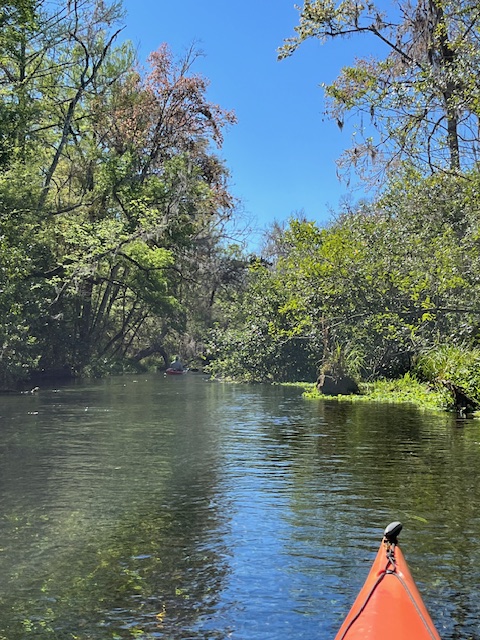
About ten miles south of town, the Ichetucknee is a crystal clear, spring-fed river lined with stately Baldcypress trees. It runs for about six miles until it spills into the tannin-stained Santa Fe. The state of Florida owns the uppermost 3.5 miles of the Ichetucknee, and they battle a constant tug-of-war: access versus preservation.
When I was growing up, no summer visit to my grandmother’s house was complete without a trip down the Ichetucknee. When we were very young, it was via canoe with my parents. But when we were old enough, we wanted to do what all the other kids did—tube it.
The popularity of tubing down the Ichetucknee has exploded—or so I’ve been told. As adulting requires, I no longer visit in the summer. And December through February (the months I can get away) are a little too chilly to be marinating your backside in spring water. Because of the large crowds, they’d had to restrict tubers to a two-mile section, and they’d created an in-park shuttle system to cut down on traffic and logistics issues. I trusted this was all for the best, but just couldn’t picture the crowds they alluded to.
Until this year.
We usually do an out and back trip on the Ichetucknee, launching at the bottom (the south end), paddling upstream to the top, then floating back down with the current. They’ve now closed the south launch to the public (you guessed it—because of the crowds) so this was the first time we’d be doing an out and back from the top.
As it was the third week in March (the latest we’d ever been there) and prime spring break week, we’d planned on getting on the river no later than 10 am. It was noon when we finally shoved off between two groups of renters—about 6-10 kayaks in each. But as the renters were mostly beginners and families in short kayaks and inflatable SUPs, and we were in our longer boats, we scooted past them quickly.
On this trip, we never experienced a stretch of river to ourselves. But the upper couple of miles were peaceful. Floating with the current over clear water mesmerizes a person. The sea grasses bend and sway below you. Purple-gray mullet dart and leap out of the water. Turtles glide past. The water turns to sapphire as it slides under moss-covered limestone banks and then to a cheerful sunny blue as it skips over the white sand bottom.
We saw a manatee munching grass along the edge, a school of twenty-four inch alligator gar eerily swaying in place pointing upstream, and, for the first time ever in the Ichetucknee, we saw alligators—two of them. Signs at the launch and take out warn about alligators being present. But in the fifty years I’ve been visiting the Ichetucknee, I’d never seen one. In a kayak, I give them a respectful distance, but I don’t fret over them. However, had I seen one as a kid, in a tube, I might never have returned!
About two miles downriver, the tubers are allowed to launch. Some paddlers launch here as well. As it is approximately the halfway point, the launch is aptly named “Midway.”
It was about 12:30 by the time we got to Midway and there was a steady flow of people launching. But, after helping a man who’d capsized in his rental kayak get back to the launch, we easily maneuvered around the clumps of tubers.
About two miles further, the tubers and all the renters have to exit the river. It is almost the end of the state park property. After the take out, the river makes a hard left, goes under highway 27, and then continues another two miles or so through private property lined with houses and piers and docks.
The state park doesn’t allow drones within park property, so we paddled out of the park and pulled up just beyond the bridge so Mitch could set up. After a couple of flights, we pointed our bows upstream for the return trip.
In the short time we were away, the situation had changed drastically. No longer were tubers coming down in clumps of two’s, three’s, and four’s. Now it was a sea of humanity. Blobs of people bobbing and bumping into each other took up nearly the entire width of the river. Criss-crossing the river to stay out of the strongest current while trying not to impale a dazed tuber became like trying to make a left turn onto Route 54 on a Saturday in the summer. You had to time your crossing, trying to figure out which way the tubers would drift. Was there a break you could squeeze through? Was that kid going to push off the other tube and ruin the opportunity?
The air no longer had the damp, earthy smell of a swamp. Now it was a tropical mixture of pineapple, coconut, maybe banana? as the scents of the hundreds of different sunscreens mingled. Screams, hollers, shrieks, splashing echoed along the Baldcypress trees. What at first we thought was a cormorant turned out to be the breathing tube of a snorkler.
Past the tuber put in, the crowds thinned a little. But a steady stream of kayakers, canoers, and paddle boarders still headed down river. The biggest challenge at this point became trying to get past the paddlers struggling against the substantial current to get back upstream (to avoid paying for a shuttle).
Now I understood. This was a Wednesday in mid March—hardly their peak season. Even so, we could have walked upriver on tubes. After seeing these crowds, I appreciate what the parks have done. That this gem of a river is still beautiful and clear and pristine and supports wildlife is only because a few people had the courage to prioritize protecting this special place instead of allowing the status quo to destroy it. I’m sure it was an unpopular decision at the time.
But my advice to anyone wanting a quiet, solitary paddle on the Ichetucknee? Pick a cold day in January!
 Let's Take This Outside