A mushroom walks into a bar. “Hey buddy,” says the bartender. “No shirt, no shoes, no service.”
“Aww, come on,” the mushroom replies. “I’m a fun-gi.”
When the instructor starts off the class with mushroom jokes, you know it’s going to be fun!
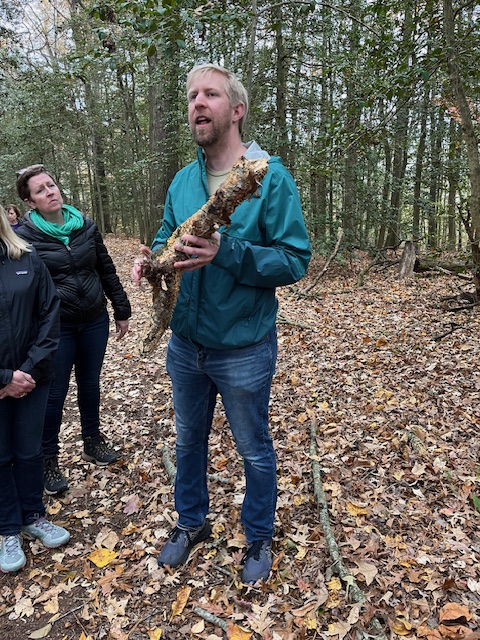
I’d first heard about this mushroom foraging class a couple of years earlier at an Assateague Coastal Trust Sip of Science event highlighting the ecological benefits of mushrooms. The speaker that evening was Matthew Harhai, founder of Goat Plum Tree Farms. He and his wife, Anmei, grow strawberries, blackberries, raspberries, figs, and more to sell at summer farmer’s markets. They also teach classes on how to create gourmet mushroom logs. At some point that evening, Matthew mentioned he was going to offer foraging classes later that summer and fall.
Wait—a foraging class? Ecological benefits are great. But I love eating mushrooms. Stuffed mushrooms, sautéed mushrooms, roasted, caramelized, chopped, fried. Imagine—walking into a forest and coming out a couple of hours later with a basket of wild, gourmet mushrooms, fresh and delicious, for free! Sign me up!
It took a couple of years to find one that would work with my schedule, but finally everything aligned. On Sunday afternoon, November 9th, I and around thirty fellow mycophiles filed into the UMD Extension Office in Salisbury for a Mushroom 101 and Foraging Class.
We spent a little over an hour in the classroom getting a crash course on types of mushrooms and identifying characteristics. Matthew also touted the many benefits of consuming and growing mushrooms:
- As a cancer treatment or to enhance existing cancer treatments
- For preventing and possibly reversing dementia
- To clean up toxic chemical spills
- To clean waterways
- To save honey bees by protecting them from a mite that is causing a mass honey bee die-off
- As a natural replacement for fiberglass blow-in insulation

He also emphasized that there is so much we don’t know about mushrooms. Hundreds more cures and uses are just waiting to be discovered. That’s why it’s so important to protect old-growth forests and outdoor wild spaces, places where mushrooms thrive. The next important discovery may depend on it.
Next was the foraging part of the class. But before we headed out, Matthew stressed the importance of completely and accurately identifying any mushroom you plan on consuming. He doesn’t trust apps. Over and over, he advised using a dichotomous key in a mushroom identification guidebook which takes you, step by step, through the entire, lengthy identification process. And he recommended using the key even as you get more confident. “You need to be 100% sure you know what it is,” he said. “There are very few mushrooms that will kill you. But sometimes, you’ll wish you were dead.”
And even when you’re sure you’ve ID’d the mushroom, he advised only eating a small amount. Label it and put it in your fridge. After a day or two, if you’re still feeling good, then you can feel confident eating the rest.
“A successful mushroom foray is one where you feel great afterwards, and still feel great a week later,” he said.
A few more of his pointers:
- ID each mushroom you pick. Don’t assume that just because they are all growing together and look similar, they’re the same type.
- Only take 25% of the cluster so you’re not wiping out the entire patch.
- Always cook wild mushrooms.
- Pick the entire mushroom, don’t break it off, because the base is an important part of the ID process
With mushroom ID cards and collection bags in hand, we were ready to go foraging. We drove to a park a couple of miles away where thirty of us headed off on the trails, and off the trails, in search of mushrooms – three species in particular:
- Pearl Oysters
- Lions Mane
- Hen of the Woods
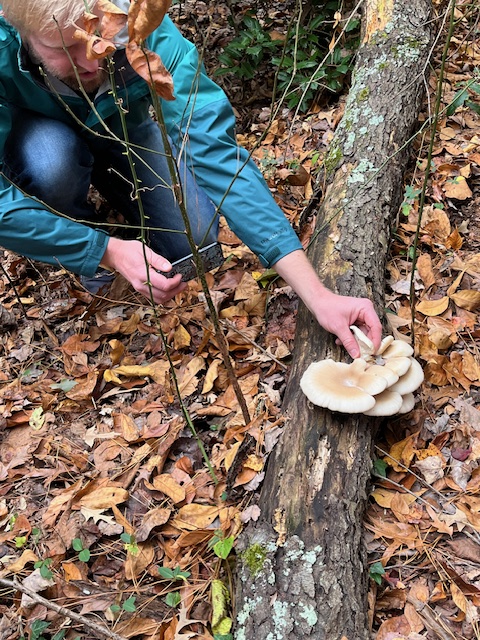
Right away we found wood conchs, turkey-tail look-alikes, and lots of LBMs (little brown mushrooms). We also found a few Amanitas (some species of which are edible and some are deadly poisonous). And one participant spotted a decent-sized pearl oyster, which we collected to bring back to the classroom to eat.

Back at the extension office, Anmei got the skillet going. Anticipating not finding enough to feed a group of thirty, they’d purchased locally grown mushrooms and had already prepped them.
We first tried hen of the woods. OMG, so good. Next, we tried lion’s mane. It was a little bitter but still so good and with a very interesting texture. According to Matthew, you could substitute it for crab in a crab cake and most people would never know (I might have to do a blind taste test before I believe that one.) Next, we tried the farm-raised pearl oyster, which was amazing. And to ‘cap’ it all off, Anmei cooked up the wild pearl oyster we’d foraged. It was unbelievable. The freshness made a huge difference.

The class ran a little over the allotted three hours, which I didn’t mind at all. I would have stayed all night if they’d continued cooking mushrooms!

While I don’t think I’ll ever trust myself enough to eat mushrooms I’ve foraged (I just don’t have the patience required to go through the whole IDing process), I learned so much from this class. Matthew’s enthusiasm was infectious and made for a completely enjoyable afternoon. It was the best $40 I’ve spent in a long time!
For more info, check out Goat Plum Tree Farm’s social media pages:
 Let's Take This Outside