
One great thing about volunteering with an organization like Delaware Wild Lands (DWL) is it gets you outside doing things you’d probably never do on your own. Like spending two hours on your hands and knees on a gorgeous fall day collecting 6,500 acorns.

In case you’re not familiar with DWL, they are the largest private landowner in the state of Delaware. Their mission is “protecting and restoring Delaware’s important natural areas through the purchase and management of strategic parcels of land.” To date, they’ve acquired 31,800 acres and actively manage 21,800 acres. They own some amazing land in the Great Cypress Swamp west of Selbyville, a gorgeous swath of bayshore in between Big Stone Beach and Bennet’s Pier in Kent County, and a number of ecologically rich properties in New Castle County, one of which had some acorns that needed to be collected.
Just outside of Odessa, a few hundred feet from the busy Rt. 13 and busier Rt. 1, five of us met at the Hugh R. Sharp Farm. DWL acquired this property in 2006. Acquired isn’t quite the right word. They rescued it. During that time, vacant land in southern New Castle County was (and still is) under intense development pressure. At a little over four hundred acres, and with its expansive view of the confluence of Drawyer Creek and Appoquinimink River, the Sharp Farm was a developer’s dream. According to Brigham Whitman, DWL’s Conservation Program Manager for New Castle County, DWL has, in its office, a conceptual layout sketch from before the acquisition. The sketch shows how the property would have been developed—the streets, the blocks, the individual lots. The Sharp Farm with its beautiful fields, forests and marshes would have been bulldozed into a sprawling subdivision with hundreds of single-family homes if DWL had not preserved it.
As we bumped along a farm road in the DWL pickup, Hannah Small, DWL Restoration and Research Manager, explained our day’s task in more detail. We were to collect acorns from the resident chestnut oak trees. The acorns will be used for a restoration project on the property. While some of the farm is still in ag and will remain so for a long time, they’d like to begin restoring other areas that are currently considered early successional habitat. A nearby nursery had agreed to take the acorns.
“They float them in water first,” Hannah explained. “The ones that sink are good.”
Those will go into pots. The nursery will grow them to about a three-gallon-size at which time DWL will take them back and plant them.
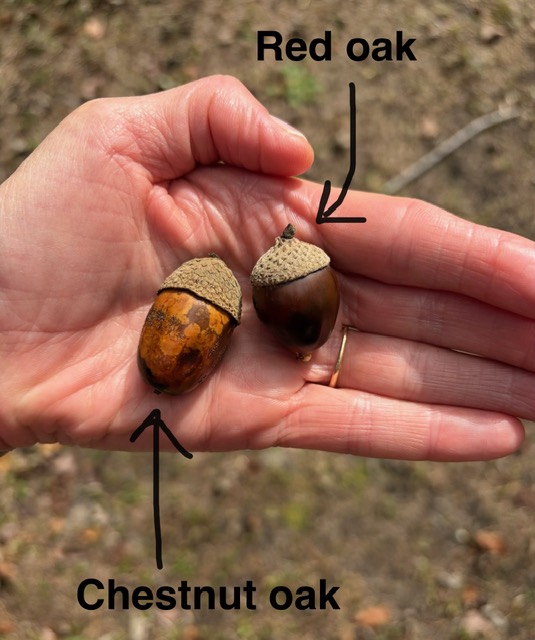
We pulled up alongside a gathering of chestnut oaks and red oaks on a bluff overlooking Drawyer Creek. Hannah picked up an acorn from the ground to show us our target. The chestnut oak is oblong, while the red oak is round. Then we each got our five-gallon bucket and walked into the trees. We worked in dappled shade, comfortable even though temperatures that day hovered in the mid-80s. Easy conversation mixed with the “plunk’ of acorns dropping into buckets.
The original plan was to collect three thousand hoping two thousand would germinate. But it was so easy and went so fast that, before we knew it, we’d each filled a bucket. Brigham had counted his acorns as he went and determined that each bucket held a little over a thousand. (The official total according to the nursery was 6,500.) Sorry squirrels!

“Wouldn’t it be cool,” Hannah said before heading back, “if you guys were the ones to collect them now and then plant them in a year or two?”
Actually, that would be very cool.
DWL properties are not open to the public. However, they frequently offer public fundraising and informational events. Two are coming up in the next couple of months:
The Flight of the Crane is a wine tasting, bird watching, opera event (what an amazing combination!) on November 7th. Details here
The Wild Winter Run is a 5K through the Sharp Farm on Dec. 5th! Details here